
By Ann Oelrich, CSP, Janet L. Keyes, CIH
Body work is dusty work. Mechanical repair isn’t as dusty – but have you ever machined a brake? Fortunately, we don’t see asbestos dust the way we used to, because no major manufacturer uses it in brakes or clutches anymore. And fortunately, the worst type of dusts, such as lead and silica, aren’t the major hazards they once were. Only very old car paint will contain lead. Silica’s no longer found in body filler or buffing compounds. On the rare occasions you do any blasting, it’s probably with coal slag (Black Beauty, Black Diamond). But breathing too much dust of any type is bad for your lungs.
How are you managing dust in the workplace? Are you removing it or just moving it around? Do you blow it off with compressed air? That’s certainly one of the quickest and most common ways to remove dust from a surface. But the compressed air doesn’t remove the dust. It simply moves it from one location to another. Heavier particles fall and settle quickly, creating additional surfaces that need cleaning. Smaller particles linger in the air for hours while you and your colleagues breathe them in. Those smaller particles, the ones that are hard to see, are the most damaging to your health.
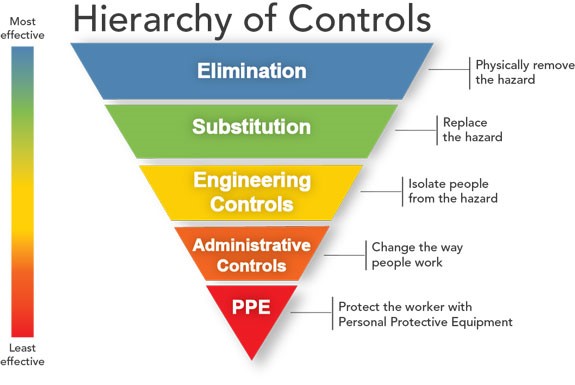
How can you control dust in the workplace? The answer, my friends, is not blowin’ in the wind. The answer is to apply a set of controls. Start with the most effective ones first.
Look at alternatives to using compressed air for cleaning. Dust capture tools, attached to grinders and sanders, remove the dust when it is created. They keep your shop from getting a fine dust layer over everything. They can speed up the work, too, because employees don’t need to stop what they’re doing to blow off the dust. You don’t need to stop all work periodically to clean the shop. You won’t have to replace air filters as often. You won’t have to worry as much about dust damaging your paint jobs. Capturing the dust at the source also reduces the fire risk from combustible dust, such as that from body filler.
You can use water to control dust. When asbestos brakes were common, that was a recommended way to control brake dust. Mechanics were to spray water with a detergent added to it to wet all brake and clutch parts and then wipe down the parts with a rag, to be disposed of as asbestos waste. People who work with stone or concrete routinely do it wet, too. The water they use controls silica dust, as long as the dust isn’t allowed to dry out. Is that feasible for your work? Probably not for sanding. But it could be an option if you’re machining brakes or even if you need to do some abrasive blasting.
Why were mechanics to use water with a detergent added? Because detergents such as dishwashing liquid make water wetter. They reduce the surface tension of water, making it more effective as a dust suppressant.
If you can’t capture the dust when it is created, you can vacuum it up. But use a vacuum with an efficient filter, so fine dust doesn’t come in one end and go out the other. Vacuuming cleans the shop floor, but takes a lot of time and effort – and it’s hard to vacuum irregular surfaces such as the clutter on top of tool boxes.
What if those methods won’t work? If you absolutely must blow it, do it right.
Require that everyone use OSHA-compliant air guns. These are designed so that blocking the tip doesn’t make the air hose pop off and whip around. They may have a port in the side of the nozzle, to divert the air flow (don’t let anyone cover that port with tape. Doing so is actually self-defeating, because that port creates a Venturi effect, actually increasing the tip pressure during normal use). Other compliant guns may have star-shaped tips or solid tips, with the air coming out from behind the tip. Those designs make it very hard to block the tip.
Require employees to wear safety glasses and hearing protection if they must use compressed air. The flying particles will get in eyes. The air itself is usually loud enough that it can damage hearing in minutes. There are air blow guns designed to be quiet (Silvent and Exair are two manufacturers of quieter compliant air guns), but they are more expensive. We rarely see those in the shops we visit.
Strongly discourage employees from using compressed air on themselves. That’s how people blow air into skin breaks, leading to infections. And never let anyone turn a blow gun on someone else.
Automotive work can be dusty. But there are better options than putting that dust back in the air.
OSHA safety grants have funded dust capture systems. For information about those, about dust control and evaluation or for other safety issues contact CHESS at 651-481-9787; toll free at 877-481-9787, or carkey@chess-safety.com.
This article originally appeared in AASP-MN News (December 2025) . It is intended to provide general information (no advice) about current safety topics
 Minnesota issued a new workers comp poster, free to
 The National Weather Service reports that Severe Weather Awareness Week for 2026 is April 13 – 17, with statewide tornado drills on Thursday, April 16. This is a good time to remind employees about preparedness – where the best shelter locations within your building are located or what to do if they are outdoors when severe weather hits. Do you have a severe weather plan? Consider these, and discuss them with your employees:
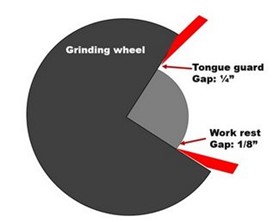 A guard around the wheel itself. This needs to cover 75% of the wheel. It keeps the user from coming into contact with the rapidly turning abrasive surface. Of more importance, it will help contain any shrapnel if the wheel explodes. That can happen if the grinder operates at a higher speed than the wheel is rated for, if the wheel is mounted incorrectly, if it wears too unevenly, or if it was damaged before it was installed (for instance, from dropping it).
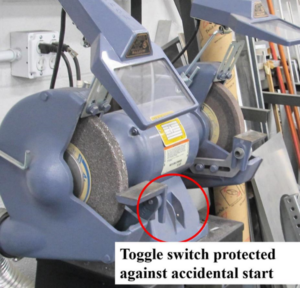 Grinders and other equipment may also need guards over their on/off switches (“motor start buttons,” to quote OSHA regs), so they can’t start accidentally. The grey grinder pictured here has that guard over its toggle switch.
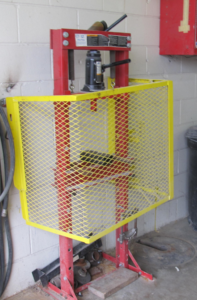 Some companies use ballistic blankets as guards, wrapping the blanket around the piece. Others fabricate their own guards (if you do that, use something that won’t shatter, such as polycarbonate or expanded metal). And some companies will sell you guards for these. Expanded metal mesh curtains are a popular option.
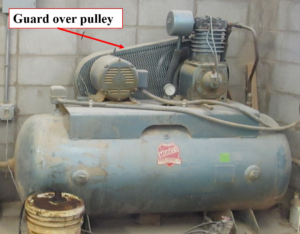 Keep guards in place. Adjust them correctly. Remove them only if the hazard is removed – the grinder unplugged, the compressor turned off and locked out so it can’t be restarted. If the guards are in the way, investigate – as they’re probably the wrong type of guard for the job.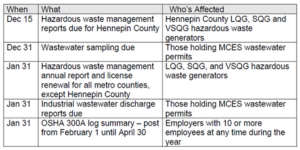
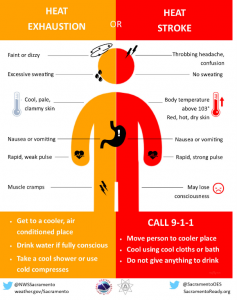 We have had roller coaster spring weather – storms, wind, rain, cold, poor air quality, heat. And heat is expected again this week into the weekend. It takes about two weeks to really adjust (acclimatize) to heat. Since we have not had steadily increasing temperatures, people may be more susceptible to heat-related illnesses.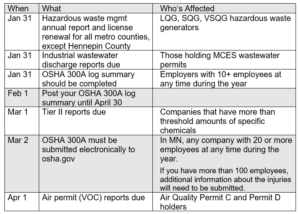
 The ANSI standard (B56.1-1969, reference in the OSHA standard) defines a “powered industrial truck” as a “mobile, power-driven vehicle used to carry, push, pull, lift, stack, or tier material.”
 Helmets: Climbing style hard hats with chin straps are often referred to as helmets, because European standards for head protection require chin straps and use the term helmet for head protection. US standards use the term hardhat. Think of helmets as a style of hardhat.
 Watch your workers, and talk to them. Look at their body positions when they work. Do your painter’s arms get tired from holding the spray gun? What tasks make their backs or shoulders ache? Do they have ideas to make work easier?
 Keeping track of those minor injuries helps you identify patterns. If you have one employee with something in the eye, you might attribute it to clumsiness or working under a very rusty car. But what if five employees report something in their eye? It might be time to look at what’s causing that. Maybe you need to rethink your policies on safety glasses in the body shop.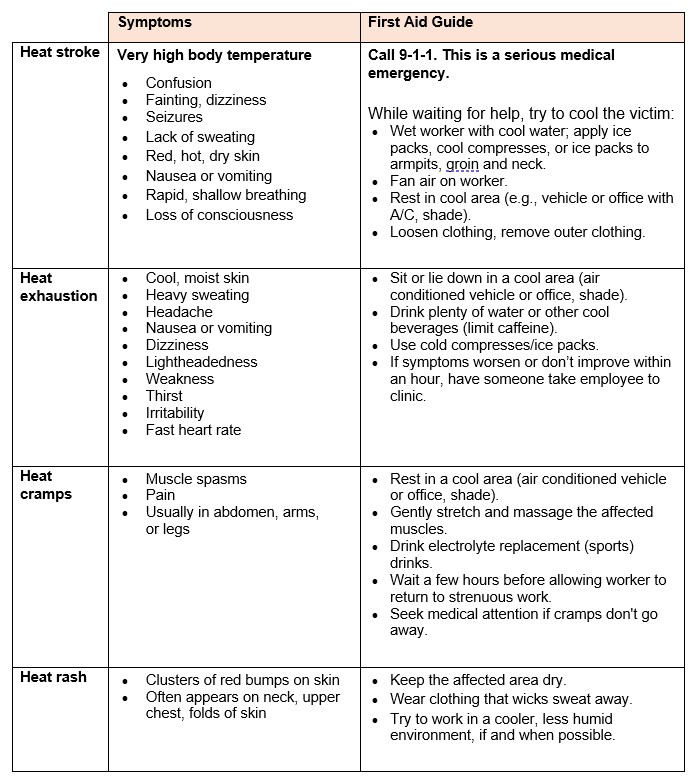

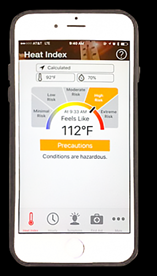 Consider using the OSHA-NIOSH Heat Safety Tool as a resource to help you determine which work activities are safe based on the current weather conditions. This app displays the real-time heat index, hourly forecasts and occupational health and safety recommendations.
 Who cares if you’re tidy and uncluttered? Your local Fire Inspector cares. The Fire Code says that “storage of materials in buildings shall be orderly.” OSHA cares. “All places of employment shall be kept clean to the extent that the nature of the work allows.” And “all places of employment…are [to be] kept in a clean, orderly, and sanitary condition. Why do they care? Because messy shops increase the fire hazard. Messy shops increase the hazards from slips and falls. Messy shops are more dangerous.
 Another question to ask your technicians: “Have you ever had welder’s flash?” Don’t be surprised if nearly all of them say yes. Ask them how it happened. Sometimes, it’s because someone else was welding near them. Sometimes, it’s from the radiation reflecting off a nearby wall. Sometimes, the battery on their autodarkening welding helmet gave out. And sometimes, inexcusably, they decided to weld without eye protection.
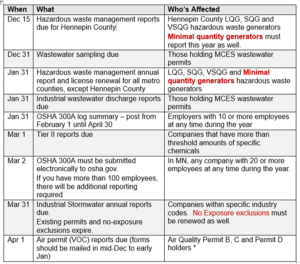
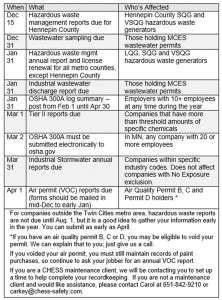 Reporting Reminders
 Eleanor Kernkamp is the newest member of the CHESS team. Many of you may have already received emails or calls from her, as she has taken over our scheduling. She also helps with reports, formatting documents, research and keeping our office running. Eleanor is a graduate of University of Wisconsin – Eau Claire. Although she grew up in Wisconsin, she is a Minnesota sports team fan. If you need to schedule training, Eleanor can be reached at 651-842-9215 or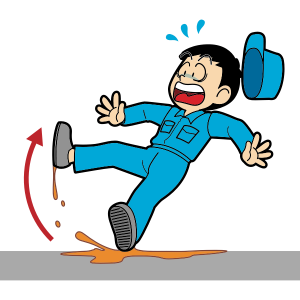
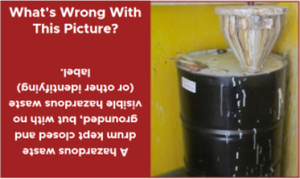 A company with operations similar to yours had a hazardous waste inspection. The inspector found solvent-contaminated rags in the trash. A drum of waste thinner wasn’t labeled as hazardous waste and its funnel was left open. They didn’t do weekly hazardous waste inspections. Solvent from a partswasher wasn’t reported on their annual report. Used oil containers were missing used oil labels. And they had no proof that employees had ever been told how to handle waste.
 That’s the scary part of heat stress and heat stroke – people don’t realize how dangerous a situation it is. Victims don’t know that they might be close to death. This man worked quietly alone, with no one paying attention to him – until he collapsed.