
Things are heating up
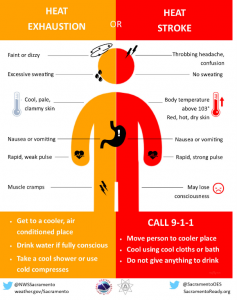 We have had roller coaster spring weather – storms, wind, rain, cold, poor air quality, heat. And heat is expected again this week into the weekend. It takes about two weeks to really adjust (acclimatize) to heat. Since we have not had steadily increasing temperatures, people may be more susceptible to heat-related illnesses.
- Learn to recognize the signs of heat-related illnesses
- Take more frequent rest breaks.
- Slow the pace of work
- Make sure workers stay hydrated and are not skipping meals.
- Use electrolyte beverages, electrolyte freeze pops and cooling towels.
- Dress for the heat – lightweight, moisture-wicking, loose clothing.
- Watch out for each other. Someone with heat exhaustion or heat stroke may not recognize or admit to how poorly they feel. If you suspect heat illness, act quickly. Heat stroke requires immediate cooling and a call to 9-1-1. A victim can recover completely – if treated quickly. But if not cooled down, permanent damage and even death can occur.
Heat related illnesses can also occur in indoor facilities, especially when temperatures get above 80⁰F. The same precautions apply for indoor workers as for those working outdoors.
Resources
The National Weather Service publishes a heat index, a rough guide to the dangers of heat. It factors in temperature and humidity. But it doesn’t consider whether you’re working in full sun, what you’re wearing, or how hard you’re working.
The American Industrial Hygiene Association (AIHA) introduced their heat stress app last year. Developed by occupational health and safety experts, this free download (available for Android and Apple) allows you to customize information for a more accurate heat stress indicator. According to AIHA’s website:
This easy-to-use tool allows users to input the following customized information that will factor into their overall heat stress risk assessment:
- Location (multiple locations can be selected)
- Intensity of workload (users can select light, moderate, heavy, very heavy)
- Clothing type (six different options)
- Cloud coverage (degree of sun exposure)
- Preferred language (English, Spanish, French, or Portuguese)
To download the app, search for AIHA heat stress.
And, it’s buggy
It is tick season and with warming climates, ticks are prolific. Most Minnesotans have probably encountered ticks at some point – preferably when removing them from clothing instead of from being embedded in skin. Tick numbers have been upticking, and so have the number of emergency room visits for tick bites. According to the National Institute for Health, Lyme disease accounts for 80% of tick-borne illnesses, but “other tick-related diseases include babesiosis, tularemia, and anaplasmosis.” Basically, you can end up with anything from a mild rash to severe allergy to red meat (thanks to the lone star tick).
How to protect yourself:
- Wear long-sleeved pants and shirts when in wooded areas
- Treat clothing with permethrin. This is a repellent spray that goes on clothing (never directly on skin). Once it dries it should work through multiple washings.
- Use an EPA-registered inset repellent (such as DEET, picaridin, or oil of lemon eucalyptus). Check the EPA website to find repellents.
- Check for ticks. They like warm spots, suck as armpits and the groin area.
Speaking of weather…
We have had several severe weather events already this year. If you have not perfected your severe weather procedures, now is a good time to review them with employees. A tornado or severe weather watch means there is a good chance of severe weather developing and you should be prepared to seek shelter. If there is a tornado warning, get to shelter immediately. A tornado warning means a tornado has been spotted or indicated on radar in your area.
- Know where the designated shelters are in your building.
- If you have employees working outdoors, review severe weather procedures with them
- Have a way to know when it is okay to come out of the shelter. That could be an app on your phone or a weather radio. Make sure they work in your shelter location.
For more information on severe weather planning:
- Minnesota Dept of Public Safety Weather Safety: https://dps.mn.gov/divisions/hsem/programs/weather-safety
- NOAA Weather Safety: https://www.weather.gov/safety
Slip Simulator
With a heat wave coming it may be cooling to think about winter and slips and falls. InBiodyn, the developer of a slip simulator that trains people how to avoid slip and falls, will have their simulator in the Twin Cities the week of August 18.
To see a video of the simulator and more information on it, go to https://www.inbiodyn.com/
If you are interested in having your employees go through their training, or for more information including pricing, contact Solana at CHESS.
Hazardous Waste Manifest Update
Have you ensured your waste made it to its final destination? You now have 60 days (instead of 45) before you need to worry.
Confirming that hazardous waste made it to that final destination is the purpose of the hazardous waste manifest, the shipping document used specifically for hazardous waste. One copy is left with your facility. When the waste gets to its final destination, that destination signs the manifest and sends it back to you. You need to match it up with the original, as confirmation that the waste ended up where it was supposed to go. Keep that final destination copy. That’s your proof that you did your due diligence to handle the waste properly. If you don’t get that final version within 60 days, you need to find out what happened (which usually involved calling the hauler). That time line was just extended by the EPA – it used to be 45 days.