
Minnesota OSHA penalties are going up Oct 1:
- Willful or repeated violation maximum penalty will go from $161,323 to $165,514.
- Willful violation minimum penalty will increase from $11,524 to $11,823.
- Failure to abate maximum penalty will increase from $16,131 to $16,550 per day beyond the required abatement date.
- Maximum penalties for serious violations, non-serious violations, and posting requirement violations will increase from $16,131 to $16,550.
Minnesota OSHA must align their penalties with federal OSHA, so annual increases for October are expected. To account for inflation, Federal OSHA increases their penalties every January.
Quick OSHA Updates
Federal OSHA continues to work on a heat safety rule, extending the comment deadline until September 30. Developing standards moves slower than a herd of snails through cold peanut butter (I know, that makes no sense). While we should be concerned about heat in Minnesota, our exposures do not compare with those in southern states. Eleven states recorded all-time high temperatures at 120 degrees or higher this past year (according to NOAA). Arizona will typically have four months of temps above 100 degrees. Those are the issues that need to be addressed.
Minnesota has standards for heat and cold exposure for indoor work (not outdoor). It’s pretty basic, listing what wet bulb globe temperature should not be exceeded for hot temperatures and requiring training, and giving a minimum indoor air temperature unless prohibited by process requirements. The standard federal OSHA is working on would only cover heat exposure and would be more extensive.
Federal OSHA has been placing more emphasis on consultation services and outreach. You can sign up for their newsletters and workplace safety reminders.
This and That
September is Suicide Prevention Awareness Month.
Suicide is one of the leading causes of death in construction workers. Here are a couple of resources:
American Foundation for Suicide Prevention
National Alliance on Mental Illness (NAMI)
Minnesota Department of Health
Substance Abuse and Mental Health Services Administration
October is Fire Safety Month.
It is a good time to review your fire prevention plans, emergency evacuation plans, make sure your fire extinguishers are accessible, in good condition and their annual inspections are up to date.
Fire drills can be scheduled for early October before cold temperatures set in.
Many fire departments will offer fire extinguisher training if you ask them. Knowing how to use an extinguisher can help employees both on and off the job.
Safety Committees
A reminder: if you are required to have an AWAIR program in Minnesota, you need to have regular safety committee meetings. If your safety committee meets twice a year, make sure you’ve held and documented your second meeting of the year. MNOSHA has a brief fact sheet about safety committees here.
Environmental and Reporting Updates
Hazardous waste
With this recent nice weather, I am not ready to think about Christmas (and winter) being less than three months away. But with fourth quarter, reporting season has begun.
Hennepin County should be sending out hazardous waste reporting notices around November 1. If CHESS helps you with reporting, Solana will be reaching out in the next couple of weeks with dates for us to come out to help with reporting.
The other metro counties (Ramsey, Washington, Dakota, Scott, Carver, Anoka) won’t send their hazardous waste reporting reminders until after January 1.
Industrial stormwater no exposure exclusion. If you qualify for the no exposure exclusion, you were supposed to recertify in 2025. The MPCA still does not have this reporting available. If and when the application service is available, we will let you know.
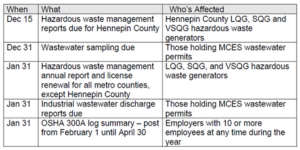
A reminder if you use OSHA’s Excel spreadsheet to fill out your OSHA 300A summary: The spreadsheet has formulas to transfer totals from the injury log page to the summary page. Make sure you don’t delete those formulas. We ran into one case where someone entered the days on restriction where the number of cases resulting in restrictions should have been entered – and that was a much higher number. If we handle your reporting to OSHA, we check that the numbers are correct. If you do it, check your numbers. OSHA uses these numbers to determine what industries to target.