Scheduling Training
CHESS has a new email address for scheduling training and meetings with the consulting staff: calendar@chess-safety.com.
Many of you worked with Noel Schneider to set up training and other appointments for the consulting staff. Noel is leaving us this month for a different job. We’ll miss him, but we’ll take advantage of his departure to establish a single email address for coordinating appointments. If you need to schedule training or a meeting with us, or change training that has already been scheduled, call us at 651-481-9787 or email calendar@chess-safety.com
Prescription Eyewear
CHESS established an agreement with Essilor, a prescription eyeglass company, so that our clients can easily set up a prescription eyewear program. Essilor has rolled out a new system which will, we hope, make it even easier. Essilor has combined forces with companies such as RayBan, Lens Crafters and Target Optical, using an all electronically managed program called Sight Protect. It allows employers to easily add employees to the system and deactivate employees.
With the Sight Protect format, you can easily decide what is required, what is expressly not allowed, what the company pays and what the employee must pay for (if, they want premium progressive lenses, for example). Billing statements are clearer, and it will be easier to see all employees in the program, including when they last received safety glasses. Best of all, prices have not gone up under this program. An employee can get bifocal prescription safety glasses with antifog for under $160. Prices under the old program with Essilor will be going up if you don’t switch to Sight Protect.
For more information, contact John Hammer at 612-840-5171 or jhammer@essilorusa.com. You can find more information about the Sight Protect program at sight-protect.com
Lab Fees Going Up
Pace Labs announced a price increase earlier this year and now will be adding an 8.6% inflationary surcharge. We offer the benefit to clients of running any lab testing with Pace through our account, which provides a significant cost savings. We will continue to do our best to provide estimated costs, but actual costs will likely vary as we try to keep up with their changes.
MPCA Grants
The MPCA has limited funding for projects to reduce air emissions for smaller businesses. The grant deadline is July 27, with notification of grant approval expected within 60 days. The maximum award is $25,000. If you are considering a project that will reduce your air emissions, it may be worth looking at this. More information is available here: https://www.pca.state.mn.us/regulations/grants-improving-air-quality-through-pollutant-reduction
Other MPCA grant opportunities can be found here: https://www.pca.state.mn.us/about-mpca/contract-grant-and-loanhttps://www.pca.state.mn.us/regulations/grants-improving-air-quality-through-pollutant-reduction-opportunities
First Aid Kits
The American National Standards Institute (ANSI) has updated the requirements for first aid kits, effective in October. Some of the changes are:
- Foil blankets will be required. Foil blankets have multiple purposes (provide heat, wind break, waterproof wrap, treat hypothermia).
- Tourniquets: The new standard clarifies information on tourniquets (they are not the same thing as the bands used to stop blood flow, such as when donating blood)
- Bleeding control kits: These are packaged kits designed for use for severe life-threatening bleeding. They contain items such as a tourniquet, gauze, gloves, marker, and very wide bandage.
- Risk assessment: employers should determine the potential hazards in the workplace, the type of injuries that could occur and ensure that first aid kits have the supplies to address those injuries.
If you use an outside company to maintain your first aid kits, they will likely inform you of these changes, and may bring your first aid kits up to date.
Reporting Spills
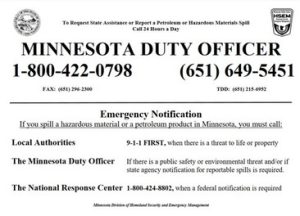 Petroleum spills greater than five gallons and spills of any amount of hazardous material must be reported to the Minnesota State Duty Officer at 651-649-5451. This number is answered 24 hours a day, seven days a week. The State Duty Officer and Fire Department (9-1-1) should be notified for any petroleum product spill over five gallons, any uncontrolled spill (regardless of location), release to the environment, when there is any risk to public health or safety, or when an employee has been unintentionally exposed to a hazardous chemical (including corrosives, irritants, flammable material).
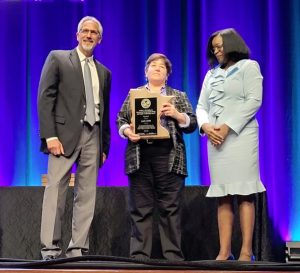 Janet presented with Arthur E. McCauley Award
 What’s in that container? We often need to ask that when we do site inspections. Is it water? Or isopropyl alcohol? Or a strong acid? Don’t make anyone guess. All containers, even those containing water, need to be labeled with the product name. If it could be hazardous, add appropriate warnings.
 What happened? The toaster oven had a non-polarized plug. It was plugged into a polarized outlet, resulting in reversed polarity – even when the toaster oven was off, current was going through the heating element. The heating element was damaged, causing it to be in direct contact with the casing of the oven. When the sweaty worker’s arm touched the oven, the current flowed from the toaster, through him, to the grounded air conditioner. Electricity is an opportunist. It will take the easiest path to ground. The human body is a very good conductor of electricity.
  Bad luck, you say? That implies that it was unavoidable. We’d argue it was the absence of good luck. The employee who lost a finger to a fan belt probably wasn’t doing anything new. He got lucky the other times. This time, his luck failed. When the same hazard is present time and time again, we should figure out how to prevent it instead of hoping luck holds.

 If we can keep people from spewing the virus whenever they breathe out, we’ll keep other people from breathing it in. That’s the idea behind face coverings (masks).


 Mouse nests burn easily. That isn’t something you want to discover when you’re doing hot work on a mouse-infested car. Mouse nests are only one of many ways to start fires in auto repair shops. Collision repair shops are at higher risk of burning down than mechanical shops, but we can find lots of ways to start fires in either shop.
 Fire Extinguisher Maintenance
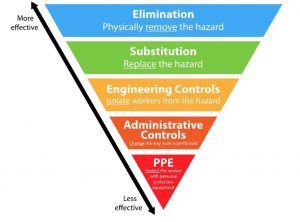 We won’t ask you to eliminate all hazards. That’s futile. A more practical approach is to use the hierarchy of controls.
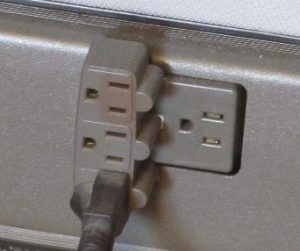 Current tap: plugs directly into an outlet.
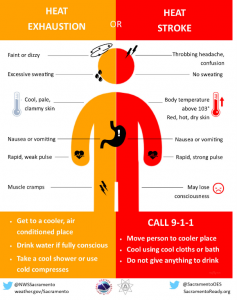 It continues to be a very hot summer in Minnesota. High temperatures, high levels of humidity and now air pollution make it difficult to do tasks we normally do easily. This week we are expected to have temperatures in the high 80s to mid-90s with high humidity. Even though we have had some time to acclimate to higher temperatures, this extreme weather can tax the most fit of us. We need to take extra precautions to stay safe in these extreme conditions.
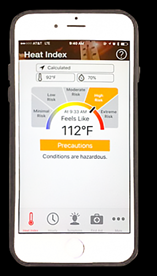 Heat Safety App
 It was bound to happen—the combination of heat and humidity that makes mosquitoes so happy and humans so miserable. The weather forecast is for heat advisory for the rest of this week, with temps in the high 80s and low to mid 90s, and high humidity. While residents in southern states may be acclimated to those temperatures, we may not be yet. The first week or two of this weather is the most dangerous, as we need time to acclimate.
 For the next few months (fingers crossed) we don’t have to worry about ice and snow. Heat and storms take their place. If you work outside, check for severe weather alerts. Know the signs of heat stress. Keep an eye on coworkers, as people suffering from heat stroke often do not realize how dangerous their condition is.
 Aerosols, particulates, viruses, masks, and COVID transmission: One of the major frustrations of this pandemic has been about masks – do they help? How much do they help? Why were they originally discouraged? Should we be wearing two or three or four or …?