
By Janet L. Keyes, CIH
Anyone have a grinder? A compressor? A shop press? Electrical panels? A mezzanine?
One thing all of those have in common: they require guarding. People stick fingers where they don’t belong – sometimes because they don’t see a hazard; sometimes without thinking. Parts break and fly out. Work creates flying chips and sparks. Wrapping employees in personal protective equipment won’t keep their hands out of a grinder. Telling people to “be more careful” won’t stop a bearing from flying out if it fractures when pressed. Guards aren’t substitutes for personal protective equipment or careful operations, but they provide safeguards.
The guards on your grinder protect the user from where the machine acts on the work piece: they are point of operation guards. The standard grinding wheel has three guards:
 A guard around the wheel itself. This needs to cover 75% of the wheel. It keeps the user from coming into contact with the rapidly turning abrasive surface. Of more importance, it will help contain any shrapnel if the wheel explodes. That can happen if the grinder operates at a higher speed than the wheel is rated for, if the wheel is mounted incorrectly, if it wears too unevenly, or if it was damaged before it was installed (for instance, from dropping it).
- The work rest. The work rest supports the workpiece so the user can maintain steady contact with the wheel. But it also reduces the risk of something such as a glove or a loose sleeve from being dragged into the wheel. It needs to be kept as close as possible to the wheel (no more than 1/8” away).
- The tongue guard, at the top of the wheel opening, and adjusted to be within ¼” of the wheel. The tongue guard can prevent pieces of a shattered wheel from flying out and striking the user. It also helps contain sparks. We often see these missing or incorrectly adjusted because many people don’t know their purpose.
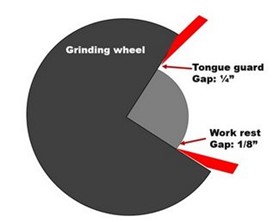 A guard around the wheel itself. This needs to cover 75% of the wheel. It keeps the user from coming into contact with the rapidly turning abrasive surface. Of more importance, it will help contain any shrapnel if the wheel explodes. That can happen if the grinder operates at a higher speed than the wheel is rated for, if the wheel is mounted incorrectly, if it wears too unevenly, or if it was damaged before it was installed (for instance, from dropping it).
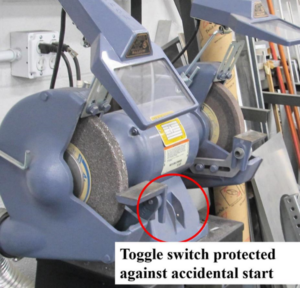 Grinders and other equipment may also need guards over their on/off switches (“motor start buttons,” to quote OSHA regs), so they can’t start accidentally. The grey grinder pictured here has that guard over its toggle switch.
Guards on hydraulic shop presses are also point of operation guards. When those presses exert tons of pressure, the piece being pressed can shatter explosively, sending fragments out with force.
The guards for these act as curtains or barriers to blunt the force. These presses usually don’t come with guards, in part because the manufacturers don’t know what you’re pressing.
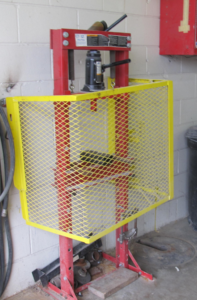 Some companies use ballistic blankets as guards, wrapping the blanket around the piece. Others fabricate their own guards (if you do that, use something that won’t shatter, such as polycarbonate or expanded metal). And some companies will sell you guards for these. Expanded metal mesh curtains are a popular option.
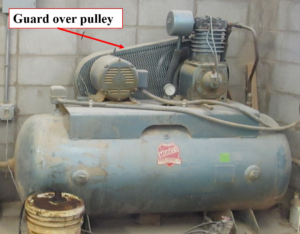
Your compressors don’t have point of operation guards, but they do need guards over the power transmission apparatus. That’s OSHA’s way of saying that belts and pulleys need to be guarded. We rarely see problems with these unless the compressor is old. But we have seen severe injuries when the guards are removed before the belt comes to a complete stop.
These aren’t the only things that need to be guarded. All of your shop’s electrical wiring should be guarded, by wire insulation or by covers on electrical components. Fan blades must be guarded, either by covers with openings too small to fit a finger or by distance. That mezzanine mentioned in the opening paragraph? Guard that with railings: a top rail at about 42”, able to withstand 200 pounds of force against it; a midrail, and a nominal 4” high toeboard. The toeboard keeps someone from sliding through the opening and, more likely to happen, keeps anyone on the mezzanine from inadvertently kicking a tool off the edge (and onto a coworker below).
 Keep guards in place. Adjust them correctly. Remove them only if the hazard is removed – the grinder unplugged, the compressor turned off and locked out so it can’t be restarted. If the guards are in the way, investigate – as they’re probably the wrong type of guard for the job.
This article originally appeared in AASP-MN News (January 2025). It is intended to provide general information (no advice) about current safety topics. To discuss your specific concerns and how CHESS may help, please contact CHESS at 651-481-9787 or chess@chess-safety.com.