
New posters available
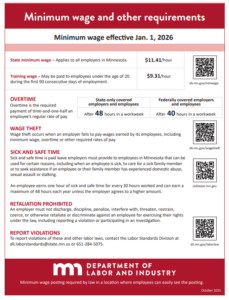 Minnesota issued a new workers comp poster, free to download here. They updated the poster to include some mental health-related injuries that may be eligible for workers’ compensation (such as persistent post-traumatic stress disorders). All businesses are required to post this and other mandatory posters in a location where employees can easily see the posters.
The state minimum wage poster was updated for 2026.
All required state posters are available as free downloads, to print on letter sized paper.
Minnesota fatal injuries increase
That is not a headline we like to see. When a loved one leaves for work, you expect them home. You don’t expect the life-changing call that there has been a fatal accident.
According to a Minnesota Department of Labor and Industry press release, “A total of 84 fatal work-injuries were recorded in Minnesota in 2024 during the annual Census of Fatal Occupational Injuries (CFOI), up 14 from the 70 fatal work-injuries in 2023. This is the highest number of fatalities since 2017 when there were 101 fatalities.”
The industry sector of agriculture, forestry, fishing and hunting had the most fatalities with 19, with farming accounting for 11 of those deaths. Private construction was a close second with 18, with just under half from roofing contractors. The leisure and hospitality sector (golf courses, country clubs, hotels) had ten fatalities and the public sector (federal and local governments) suffered 12 in 2024, up from three the prior year.
The most common type of incident leading to deaths was transportation, with 25 fatalities. That includes car accidents, pedestrians struck by vehicles, and work zone incidents. Fatal falls, slips and trips, either to a lower level or on the same level, almost doubled. Violent incidents also increased.
The Census of Fatal Injuries includes fatalities not covered by MNOSHA, such as traffic accidents or those involving self-employed people.
And this from OSHA…
OSHA 300 logs must be posted until April 30. If you are required to submit your logs electronically (in Minnesota, that is any company with 20 or more employees), that should have been done by March 2. Even if you missed the deadline, you should still submit.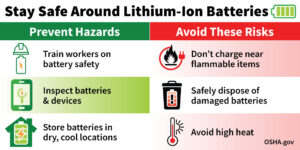
Severe weather awareness
 The National Weather Service reports that Severe Weather Awareness Week for 2026 is April 13 – 17, with statewide tornado drills on Thursday, April 16. This is a good time to remind employees about preparedness – where the best shelter locations within your building are located or what to do if they are outdoors when severe weather hits. Do you have a severe weather plan? Consider these, and discuss them with your employees:
Who will decide when to seek shelter?
What will your protocols be? Will you lock the building? Will someone have a weather radio? How will you account for everyone?
If a power line comes down in your parking lot, does everyone know what to do? They should call 9-1-1 and stay at least 40 feet away from it. Never assume downed power lines aren’t live.
Heat injuries in winter (well, actually early spring)?
You probably don’t think heat’s in issue in Minnesota winters. But winter is a good time to plan how you’ll handle heat in summer. And heat can be a problem even in the dead of winter if you have hot processes such as baking, dry cleaning, powder coating ovens, incinerators or furnaces for melting metals.
Minnesota has a heat standard, but it only applies to indoors, not outside. Workplaces that aren’t air-conditioned could exceed the indoor standard when the outdoor temperature rises. How would you handle that? If your employees work outside, do you have plans for ensuring their safety when the weather turns hot?
According to a recent review by the Minnesota Department of Labor and Industry, Minnesota averages about 37 work-related heat illness workers comp claims a year. Almost one-third of those resulted in paid indemnity benefits, meaning that those employees lost more than three days of work due to heat. The industry sectors with the most claims: construction, manufacturing, and public administration (especially police and fire), followed by waste management and remediation services, and then transportation and warehousing.
Over a quarter of the claims were from those 25-34 years of age. And 40% had been on the job less than a year; 75% less than five years. That fits with other studies, where new workers are consistently more at risk of heat illnesses.
California has had an outdoor heat standard since 2005. A study of its impact showed that it reduced heat-related injuries by 14% to 27%, depending on the industry. Its biggest impact was for temperatures greater than 95ºF and for workers younger than 35.
Minnesota OSHA is not planning to develop an outdoor heat standard, but you still need to protect your employees from heat. If you don’t, you might pay for claims. And you’ll pay for reduced productivity if employees get too hot.
Most heat related illnesses and fatalities occur in the first days of warm to hot temperatures, before employees become acclimated.
Where to find us
Carol will be in Kansas City in early April for the American Society of Safety Professional (ASSP) Regional Operating Committee meeting. This is an opportunity for ASSP chapter leaders in this region to get together and share information. Carol is currently president of the Northwest Chapter (MN, SD, ND, western WI) of ASSP, a term that ends July 1. Before the end of her term, she will be going to Anaheim for the American Society of Safety Professional conference in mid-June. This is always a great opportunity to learn about new products, new personal protective equipment, and attend educational sessions. If there is a product you are looking for or a challenge you are having, let Carol know. She enjoys shopping the huge expo.
Janet will be headed to AIHAConnect, the annual conference for the American Industrial Hygiene Association, in New Orleans the beginning of June. Janet serves on three national technical committees: thermal stress working group, construction committee and confined space committee. She always comes back with interesting research and innovations in the industry.
Where not to find us: after 15 years, Betsy, our office manager, is planning to retire in early June. It is hard to imagine our office without her. Betsy cannot be replaced but if you know someone who might be interested in this part-time position, they can reach out to hiring@chess-safety.com .
Thank you for reading this edition of the CHESS, Inc. newsletter! If you have questions or need assistance with workplace safety, health, or compliance, we’re always just a call or click away. Stay safe, and we look forward to seeing you in the next issue.