

Happy New Year
Whether you are reading this at the end of 2022 or the beginning of 2023, we hope you had a good year and that 2023 is bright, healthy and prosperous for everyone. We are grateful for your business and your commitment to safety. (“Raptor” – photo by Joe Ferrer.)
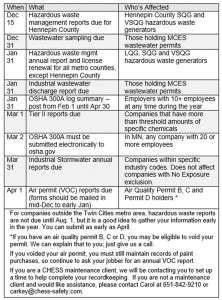 Reporting Reminders
For our maintenance clients in the Twin Cities metro area (other than Hennepin County), Eleanor will be reaching out to you soon about scheduling a time for Mary and Carol to do your annual hazardous waste reporting.
OSHA 300 logs need to be completed in January as well. We will reach out to maintenance clients, but if you are not a maintenance client and need assistance, let us know. You will need to have your First Reports of Injury, average number of employees and total hours worked.
- For average number of employees, you can look at a sampling of payrolls through the year to determine how many people were paid each time.
- Total hours worked does not include vacation, holidays or other time off.
Environmental Reminders
Floor Dry: If you use sorbents such as mats or floor dry to soak up spills, the sorbents must be handled as regulated or hazardous waste; they cannot go into the trash. We recommend getting a small drum for the used material. Floor dry can often be used multiple times until it is saturated.
Cleaning out your floor drains?
Floor drains collect all sorts of stuff – sand and salt from outside, oils from vehicles or machining, and the general muck that collects on the floor. Is it hazardous? It depends.
If you follow best management practices for floor drains, you can assume any sludge is non-hazardous. Once the water’s drained off, you can dispose of it as industrial solid waste. You can also mix it with your floor dry and other oil-contaminated waste. Any floating liquids (those separated out by your flammables trap) can be handled as used oil. The water can be discharged to the sanitary sewer, as long as your sewage treatment plant is okay with that (and you followed the best management practices).
What are the best management practices? Use drip pans to collect any fluids that drop off from cleaning parts or changing vehicle fluids. Avoid hosing down your floor – use dry sweeping compounds if needed. Clean up all spills right away. Prevent spills by keeping containers closed, labeled, and stored securely.
For more details on handling floor drains, see the MPCA fact sheet at https://www.pca.state.mn.us/sites/default/files/w-hw4-18.pdf
Managing aerosol cans: If an aerosol can is damaged, such as the nozzle breaking off, so the rest of the material in it cannot be used, the first option should be to try to return it to the supplier for a replacement. According to the Minnesota Pollution Control Agency (MPCA), aerosol cans “may be hazardous because the liquid product is hazardous [or] the gas propellant or product is hazardous, usually for ignitability.”
Do not put aerosol cans in normal solid waste. You can collect aerosol cans for disposal as hazardous waste by placing waste cans in a drum and shipping to a site that will manage them properly. The MPCA says you may puncture cans as long as you:
- Collect and properly manage all liquid residue. That typically means draining them into a hazardous waste drum.
- Meet any applicable Minnesota State Fire Code requirements.
For more information, see the MPCA fact sheet in waste aerosols: https://www.pca.state.mn.us/sites/default/files/w-hw4-00.pdf
Batteries: Where would we be without batteries, at work and at home? Can you imagine young children and Christmas and no batteries? But most batteries contain heavy metals, such as cadmium and lead, so should not go into landfills. Rechargeable and lithium batteries may not go in the trash. All batteries pose a potential fire hazard. When disposing of batteries:
- Tape the ends of each battery with clear tape. That protects the ends from accidental contact, reduces fire hazards and still allows whoever is handling the batteries to see what kind it is.
- You can keep batteries in a plastic pail or similar container until you are ready to recycle them.
Batteries can often be returned to where they were purchased, or brought to one of many disposal sites. You can check your county hazardous waste website for options.
OSHA Updates
Companies with 20 or more employees must submit their OSHA 300 logs to federal OSHA by March 1. If you do the submittal yourself, you will need to create a Login.gov account this year. If CHESS submits your log, there is no other action you need to take. For more information, see https://www.osha.gov/injuryreporting
While 2021 saw a decrease in overall workers’ compensation claims, there was an increase in work-related fatalities. 80 workers in Minnesota died on the job in 2021, a significant increase from 67 work-related fatalities in 2020. The biggest increase was in trade, transportation and utilities sectors.
From Oct 1, 2021 through Sept 30, 2022, Minnesota OSHA investigated 53 fatalities. MNOSHA does not investigate work-related fatalities when another authority has jurisdiction, such as law enforcement investigating motor vehicle accidents.
- 17 COVID-19
- 9 Struck or crushed by equipment
- 9 Fall
- 8 Engulfed or caught in or by equipment
- 3 Electrocuted
- 7 Other
Prevent Slips and Falls
It’s that icy time of year again. To prevent slips and falls on ice:
- Plow and shovel all walkways. Use salt judiciously to protect the environment.
- Put both feet solidly on the ground when getting out of vehicles. Step down, not out.
- Wear proper footwear with good tread.
- Walk with hands free to help maintain balance.
- Take smaller steps.
- Stay on pathways (no short cuts)
- Expect icy conditions in areas that are in shadows.
COVID Updates: Free Test Kits
We promise this will be short. Yes, it is still around. As is the flu and RSV. Vaccines help. Masks, good ventilation and hand washing help.
Order free test kits: Rapid at-home COVID-19 test kits are available for free for residents of Minnesota (and Wisconsin), while supplies last. Just click on the link, fill in your mailing info and you should get the kits in short order. https://mn.gov/covid19/get-tested/at-home/index.jsp
Each household can get four kits, which have a six to twelve month shelf life.