
By Janet L. Keyes, CIH
If you were asked how to control the hazards from using spray paint, what would you answer?
Often, the first answer given is “wear a respirator.” That’s a reasonable response, but it isn’t the best response. Why not? If you’re going to use a respirator effectively, it has to be the right one for the job. It has to fit you well. It needs to be maintained. It only protects the person wearing it, not the other people in the area. It doesn’t eliminate the fire hazard from the spray paint. It doesn’t protect your skin or, usually, your eyes.
You can add gloves to protect your hands and safety glasses to protect your eyes. But the gloves need to be effective against the chemical. A lot of gloves can’t hold up to the solvents in thinner; they’ll disintegrate. Gloves reduce dexterity. Safety glasses don’t seal, so chemicals can get past them. You could use chemical safety goggles, but those can be uncomfortable. And neither gloves nor goggles protect people near you.
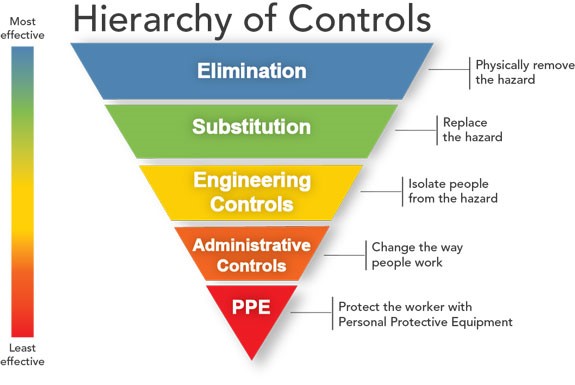
We consider personal protective equipment such as respirators and gloves to be the last line of defense, not the first. In the safety and health field, we cite the hierarchy of controls:
- Can you eliminate the hazard? If not,
- Can you substitute something that’s less hazardous? If not,
- Can you use engineering controls? If not,
- Can you use administrative controls, changing work practices? If not, then
- Fall back on personal protective equipment.
Let’s look at two real-life examples:
A shop employee received a cut on his hand when he was emptying trash. He reached into a dumpster to push the trash down and a razor blade cut his hand badly enough to require stitches. How would you have prevented recurrences?
You could have the employee wear heavy or cut resistant gloves. That’s not a bad idea if anyone must reach into trash containers. But you’ll need to make sure anyone who might reach into the trash has those gloves available. We can think of several other options.
Use administrative controls: Instruct employees that razor blades cannot go into the trash. Along with that, provide convenient containers for the blades. We’ve seen sharps containers used for that purpose. If you do that, cover up or remove the biohazard warning on those. Better yet, just use empty paint cans with lids. Cut a slot in the lid and label the can “used blades.” Provide enough of those that no one has to search for one.
Consider engineering controls. Is there another tool such as a putty knife that would do the same job? One that wouldn’t be disposable? Or one with a retractable blade?
The other example: a shop applies undercoatings. The product they used contained acetone, hexane, and asphalt. Acetone and hexane catch fire very easily. Hexane has been shown to cause nerve damage. The work was usually done in a repair bay, with the vehicle on a lift. The product directions call for it to be sprayed on. When we looked at what controls were needed, we advised that it needed the same controls as required for painting vehicles:
- This was spray application of a very flammable liquid. So it needed to be done in a spray booth or a spray area, an area with explosion-proof wiring, adequate mechanical ventilation, and fire suppression.
- The person applying the undercoating probably would need to wear a respirator. But we would need to monitor the air during application to confirm that, and to determine how long a respirator would last. If a respirator is required, then the employee needs medical approval, annual training and annual fit testing. The respirator would need to be maintained correctly.
- Chemical resistant gloves would be needed. There are few gloves that hold up to acetone. Thin nitrile gloves, costing 30 cents a pair, won’t work. $35 a pair thick butyl gloves will.
- Any waste from this or from cleanup will be hazardous waste.
A quick Internet search showed at least one alternative product, a water-based undercoating. It isn’t flammable, so applying it in a repair bay is acceptable. We don’t think any respirator will be needed. We still recommend gloves, but the thirty cents a pair nitrile gloves will work. And use of this product won’t generate hazardous waste. Even if the water-based undercoating costs more to purchase, it will cost less to use.
In this case, we can use one of the best types of controls, substitution.
When you’re faced with trying to decide how to protect your workers or yourself, don’t immediately go for personal protective equipment. Instead, consider the hierarchy of controls. Can you eliminate the hazard? Substitute something less hazardous? Use engineering controls? Change work procedures? We don’t think you can eliminate PPE. But if we can reduce our reliance on things people have to wear, employees will be safer and your costs, often, will be less.
This article originally appeared in AASP-MN News (December 2024). It is intended to provide general information (no advice) about current safety topics. To discuss your specific concerns and how CHESS may help, please contact CHESS at 651-481-9787 or chess@chess-safety.com.